The Man at the Helm
“Arthur Vance stood in the freezing dark six light-years from Barnard’s Star, looking down into his own dead eyes.”
"Keep your chin down on the rubber pad, Arthur," Dr Evelyn Kwan said, the sharp wintergreen snap of her nicotine gum cutting through the cold formalin smell of St Jude's Sub-Basement Three. "If you twitch while I've got two inches of titanium needle between your second and third cervical vertebrae, you'll spend the next fortnight dribbling your tea down your tie."
"I don't wear a tie anymore, Evie," Detective Inspector Arthur Vance murmured against the padded leather headrest of the procedure chair. "And your table's cold."
"It's a municipal mortuary, not a health spa in Bath. Hold still."
They were inside the four-metre lead-lined radiological quarantine room at the back of the morgue—the exact same cracked-tile box where, ten months ago, Vance had pressed an ultrasound wand over his right hip and discovered that he had never been a fourteen-year-old boy in Manchester.
Now the portable ultrasound cart sat pushed into the corner behind a new piece of machinery: a high-backed, gimballed neurological framing chair salvaged from the Charter Spire after the Noon Seizure, fitted with a curved horse-shoe magnetic alignment halo that cradled Vance's temples and forehead while exposing the shaved nape of his neck.
Vance kept his eyes closed as Kwan swabbed the tiny permanent titanium micro-port recessed into the skin at the base of his skull.
He was twenty-eight months old today.
Eight hundred and fifty-two days since he had been drained out of Vat-Cell 09-Delta aboard Orbital Terminal Acheron. Under the old Centauri Starlines regime, he would have been dead for four months by now—his brain uncoupled from its own memories like Julian Thorne's, his body quietly reclaimed under Section Fourteen and pumped back up the tether as grey amino powder.
Instead, on the first Tuesday of every calendar month, he came down the spiral basalt stairs to Sub-Basement Three, rested his forehead in Evelyn Kwan's alignment cradle, and let her push four millilitres of Compound L-14 straight into his cerebrospinal fluid.
"Initiating magnetic guidance lock," Kwan said behind him, her rubber-clogged boots shifting on the duckboards as she threw the heavy rotary switch on the headrest transformer. "You'll feel the usual buzz behind your teeth while the coil maps the port depth. Thirty seconds. Don't clench your jaw."
A low, sixty-cycle hum vibrated through the bone of Vance's brow.
Behind his closed eyelids, the darkness didn't stay black; as the high-field spin-resonance coils inside the horse-shoe headrest spun up around his cranium, a faint violet lattice of phosphenes flickered across his visual cortex like distant lightning seen through a curtain. For twenty seconds, a queer, weightless echo seemed to riffle through the shelves of his memory—a brief flash of the rain on Basalt Wharf this morning, the smell of ginger tea in his tin mug, the face of Chloe in her yellow raincoat, the four-thousand-volt flash on Acheron—as though someone were rapidly thumbing the pages of his notebook from back to front.
"Port alignment confirmed," Kwan's voice came from the console, curiously flat and clinical as she watched her amber monitor behind his back. "Pushing the scaffold now. Cold going in."
Vance felt the familiar icy ache bloom at the base of his skull and spread warmth down his shoulders into his arms.
On his lap, his left hand—clad in a stiff black leather half-glove that covered the palm and the permanently fused, hook-curled fourth and fifth fingers—gave a sharp, genuine throb.
Four thousand volts of free-electron laser bus-bar current had cooked those tendons solid ten months ago during the Noon Seizure. Dr Kwan had offered twice to sever the damaged ulnar nerve branch so the hand wouldn't ache when the barometric pressure dropped before a red-dwarf flare. Vance had refused both times. That crooked, stiffened two-finger hook was the only mark on his entire body that hadn't been drawn onto him with a cosmetic laser to match a dead man's file. It hurt because he had earned it himself.
The sixty-cycle hum of the headrest died away. Kwan unlatched the padded temple clamps and peeled off her latex gloves.
"There," she said, sticking a small circular fabric plaster over the cervical port at the back of his neck and handing him his collar stud. "Intrathecal pressure's textbook. Hippocampal-amygdala coupling is ninety-nine point four per cent stable. You're good for another thirty days of terrorising the night-shift, Arthur."
Vance sat up slowly, rolling his neck until the stiffness cleared, and buttoned his grey wool shirt.
"How are the stocks holding up on Ring One?" Vance asked, reaching for his trench coat on the porcelain sink hook. "The union committee at Stepney says you've got forty-two thousand Earthers on the monthly L-14 register now."
"We've got enough raw synthetic alkaloid precursors in the Acheron vats to keep the clinics supplied for another fourteen months," Kwan said, turning back to her terminal and clicking shut a sub-window on the monitor before ejecting a small silver optical backup cartridge into her apron pocket. "After that, unless the chemistry boys in Sector Seven figure out how to synthesise fluorinated indole rings out of volcanic sulphur brine, we're going to need off-world pharmaceutical shipments. And Earth is still three years and five months away from even hearing your laser pulse."
Before Vance could button his coat, the heavy lead-lined door of the quarantine room was hauled open from the corridor.
Detective Inspector Mairead Sabir stood on the threshold, rain dripping from the peak of her cap onto the silver Inspector's pips on her shoulders. She hadn't taken the time to use the stairs; by the flush in her pale cheeks and the smell of ozone on her cuffs, she'd dropped straight down the emergency pathology freight lift from the street.
"Guv," Sabir said, not even pausing to catch her breath. "Put your coat on. My brother Tariq just rang down on the secure tether line from Acheron Harbour Control."
Vance's fingers stopped on his brass belt buckle. "The Vanguard vats?"
"Not Acheron," Sabir said, her wide hazel eyes dark under the fluorescent tube. "Out past the Orpheus comet rigs. That five-kilometre dark ring Starlines was building at Lagrange Point Four—the one the captured engineers claimed was an unfinished solar-flare capacitor."
Vance glanced slowly from Sabir to Dr Kwan. Noticeably, for about two seconds, Evelyn Kwan's jaw had stopped chewing her gum.
"It wasn't a capacitor," Sabir said quietly. "Twenty minutes ago, it keyed open from the other side. And a ship just came through it."
Two million kilometres sunward-trailing of Proxima Centauri b, where the gravity of the red dwarf and the rocky planet balanced in a cold gravitational hollow, there was no roof-rain and no red twilight—only hard vacuum and the blinding, unshielded glare of a flare star hanging against the black.
Through the forward armoured quartz viewport of the Coalition customs cutter Resolute, Arthur Vance braced his black-gloved left hand against the overhead grab-rail in the zero-gee cockpit and looked at a hole in the universe.
Four kilometres off their starboard bow hung Gate-Station Lazarus-Proxima.
For thirty years, every time an off-duty stevedore on the New London tether had asked why eighty per cent of the refined dysprosium-164 and magnetosphere-catalysed antimatter pods leaving the smelters were being shipped out to an empty patch of space at L4 instead of fired back toward Earth, Centauri Starlines had called it the Outer Magnetosphere Shield Project.
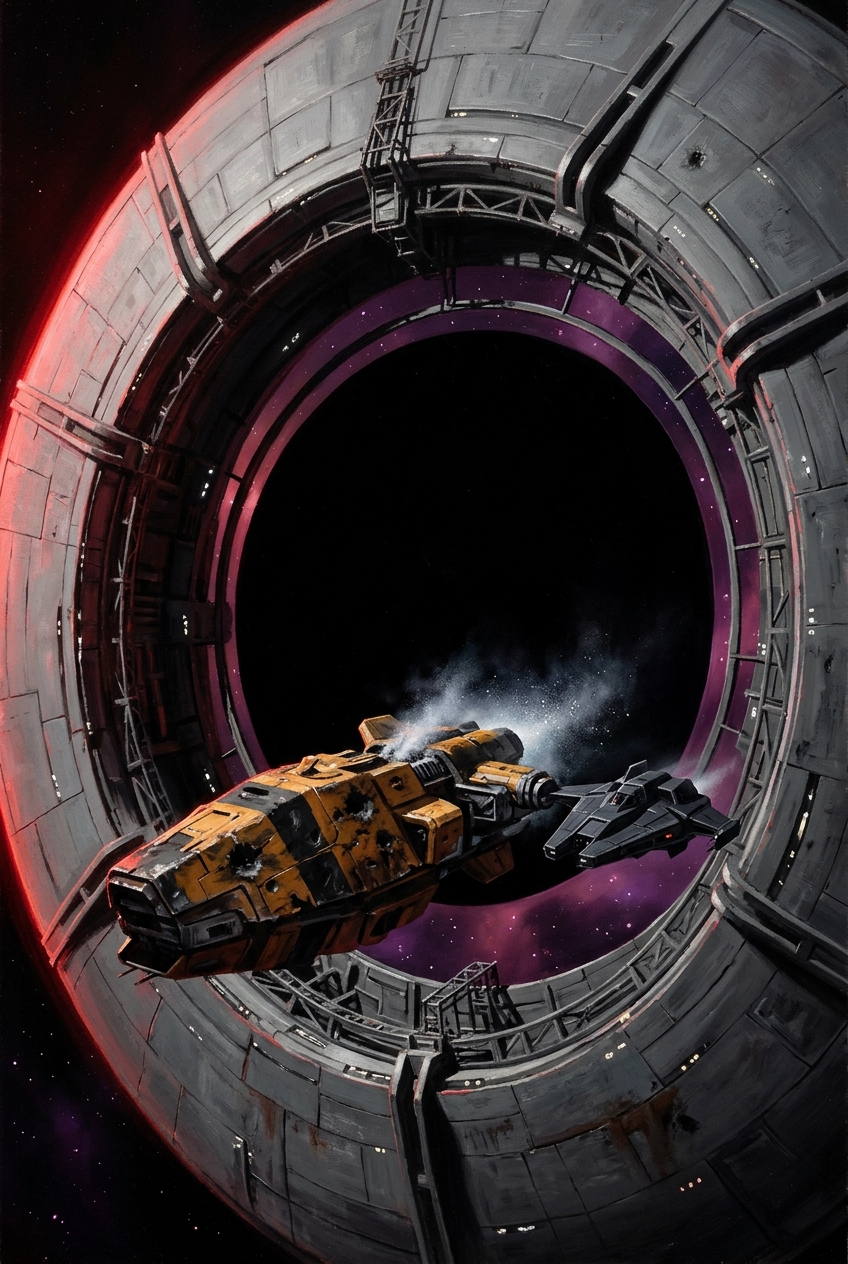
In reality, floating in the dark like an iron wedding ring five kilometres across, sat a colossal superconducting toroid plated in interlocking grey Casimir-cavity tiles.
And the centre of the ring wasn't empty anymore.
There was no swirling blue whirlpool, no Hollywood lightning storm. Inside the five-kilometre circle of grey metal, the starfield of Proxima Centauri simply stopped—replaced by a flat, mirror-black disc of folded spacetime looking straight across 5.96 light-years of vacuum into a completely different sky.
Through that five-kilometre round window burned another sun: smaller, older, and dimmer than Proxima, glowing a deep, dying ember-violet like the last coal at the bottom of a cellar grate.
"Barnard's Star," Tariq Sabir said from the cutter's co-pilot couch, tapping his four-claw titanium prosthetic against the navigation radar display. "The astrometric computer matched the pulsar bearings through the aperture ten minutes after it opened. That's the Terminus system on the other side of that glass, Inspector. Six light-years away, and you could throw a spanner across the border."
"How long does the hole stay open?" Vance asked, his eyes moving from the giant violet eye in the ring to the small, scarred silhouette drifting two hundred kilometres on the Proxima side of the threshold.
"According to the telemetry headers we pulled off the gate's automated beacon, it's a thirty-six-hour tidal cycle," Tariq said. "The aperture pinched open from the Barnard's Star side for ninety seconds to pass one vessel, then dropped back to a hairline carrier-beam standby. The next physical transit window doesn't cycle for thirty-one hours."
Sabir leaned forward between the pilot seats, adjusting the magnification on the forward optical camera. "There she is."
Tumbling at a lazy half-revolution per minute against the black sat a sixty-metre deep-space ore cutter.
Her blunt bow was painted in the rusted ochre-and-black stripes of an industrial caldera tender, stencilled across the dorsal airlock in faded white block letters: THS CORMORANT — REGISTRY: TERMINUS CALDERA RING 4.
She hadn't come through the wormhole peacefully.
Along her port flank, fifty or sixty high-velocity magnetic hyper-shrapnel impacts had cratered the outer Whipple shield, venting a frozen white halo of twinkling ammonia coolant crystals that drifted around her hull like diamond dust. Her main fusion torch was dead cold; only her automated forward cold-gas thrusters had fired in a pre-programmed braking burn after clearing the gate.
"Did she transmit a mayday?" Dr Evelyn Kwan asked from the rear jump-seat. She was already zipped into a grey municipal boarding pressure-suit, her medical kit strapped to her thigh and her helmet tucked under one arm.
"Not a word on voice," Tariq replied. "Just a tight-beam automated navigation transponder ping aimed straight down the Proxima harbour frequency. Look at the destination header on the ping."
Tariq flicked the decoded data line onto the upper repeater screen:
VESSEL: THS CORMORANT // AUTOPILOT LOCK: ORBITAL TERMINAL ACHERON — PROXIMA B
PRIORITY CUSTODY DIRECTIVE: DELIVER UNOPENED TO DET. INSP. ARTHUR VANCE (BASALT WHARF CID)
In the cramped cabin of the cutter, the hum of the CO2 scrubbers sounded suddenly very loud.
Sabir turned her head slowly and looked at Vance. "Who the hell do you know on Barnard's Star, Guv?"
"Nobody," Vance said quietly, lifting his helmet off the rack. "Bring us onto her dorsal collar, Tariq. Mairead—check the charge on your carbine."
The interior of the THS Cormorant hadn't lost pressure, though the environmental heaters had tripped out three hours ago, dropping the narrow steel companionway behind the dorsal airlock to minus twelve degrees centigrade.
And the gravity was wrong.
Because the ship's internal spin-drum was still turning on flywheel momentum, it was set not to Earth's one-gee, nor to Proxima's 1.12g, nor to Acheron's easy three-tenths. It was spinning at a punishing, leaden 1.28g—the baseline surface gravity of the super-Earth world she had launched from.
As Vance dropped down the airlock ladder onto the deck grating in his heavy pressure-suit, his forty-seven-year-old knees gave a sharp crack, and twenty extra kilogrammes of invisible iron settled straight across his collarbones.
"Bloody hell," Sabir muttered behind him, her magnetic carbine raised to her shoulder and her helmet lamp cutting a white tunnel through the freezing mist of their own breath. "Whoever lives at one-point-two-eight gees must have spines like railway sleepers."
Then her torch beam hit the first bulkhead turn, and she stopped talking.
The forty-foot central companionway leading forward from the engine room to the bow navigation blister was an abattoir.
Five men lay dead along the narrow steel passage, frozen stiff in the sub-zero cold. They weren't ore-miners; all five wore heavy, matte-black ballistic pressure-armour stamped on the shoulder plate with a crimson volcanic-crater emblem and the words: THARSIS SYNDICATE — INTERNAL SECURITY. They were armed with short-barrelled magnetic flechette carbines.
Or had been.
Vance crouched slowly in the punishing 1.28g pull beside the first two bodies wedged behind the galley service hatch, keeping his torch beam off the pooled, frozen blood on the deck plates while he read the geometry of the fight.
"They came through the aft engineering lock while the ship was accelerating toward the wormhole," Vance said quietly into his helmet mic. "Five-man boarding team. Professional entry."
"They didn't get twenty feet," Sabir murmured, stepping carefully past a third trooper slumped against the fire-main manifold and shining her light on the cluster of silver-grey impact stars punched into the bulkhead beside his head.
She stopped. Slowly, she crouched down until her faceplate was six inches from the dead third trooper's helmet visor, then looked back along the line of sight toward the dark L-bend of the forward companionway.
"Guv," Sabir said. Her voice over the intercom had gone very strange. "Come and look at this grouping."
Vance walked forward, his boots ringing heavily on the 1.28g grating, and looked where her red laser sight was pointing.
Whoever had been defending the forward companionway hadn't sprayed panic fire down the corridor. He had wedged a steel galley trolley at a forty-five-degree angle across the lower conduit pipe to force the lead boarders to step left into the light, braced his weapon low against his left forearm around the blind stanchion corner, and fired five two-round bursts.
Every single pair of tungsten slugs was spaced less than an inch and a half apart—the first round cracking the lower rim of the target's polycarbonate neck-ring, the second riding the recoil straight up through the chin-seal.
"Left-arm corner brace," Sabir whispered, turning her helmet to stare at Vance through her visor. "Low-pivot double tap onto the neck gasket. Guv... there's only one tactical instructor in the Met who taught that corner drill, and you spent three weeks drilling it into my Sector Seven sergeants at Basalt Wharf last November."
Vance didn't answer. Beneath his pressure-glove, the fused hook of his scarred left hand ached in the freezing cold.
He walked past the fifth dead contractor to the forward end of the passage.
Here sat the oval titanium blast door of the Bow Navigation Blister.
A heavy trail of dark, frozen arterial blood led from the L-bend corner straight through the hatchway. Once inside, the lone defender had dogged the manual wheel shut and used an emergency portable plasma-torch to fuse the bottom latch-pin solid to the frame from within, locking himself inside the cockpit while the ship coasted toward the Lazarus Gate.
"Tariq," Vance called over the umbilical channel. "Bring the thermal cutter down here. Take the bottom pin off this hatch—and don't cut deeper than an inch."
Two minutes later, in a shower of orange sparks that hissed and died on the blood-frosted grating, Tariq's plasma lance sheared through the welded pin.
Vance took the heavy steel pry-bar in his good right hand, hooked it behind the wheel dog, and hauled the oval hatch open.
The cockpit blister was barely two metres wide, lit only by the cold green-and-amber glow of the helm instrumentation and the vast, silent five-kilometre black mirror of the wormhole hanging outside the forward armoured windscreen.
On the main flight console, the green arrival prompt blinked steadily:
GATE TRANSIT COMPLETE // PROXIMA CENTAURI L4
CUSTODY DIRECTIVE: DI A. VANCE — BASALT WHARF CID
Slumped face-down across the manual thruster quadrant, wearing a torn, blood-soaked charcoal wool trench coat over a civilian shirt, sat the pilot.
He had taken two flechette rounds through the lower right ribs during the corridor fight—a slow, fatal liver and portal-vein bleed. He had lasted just long enough to weld the cockpit door behind him, lock the autopilot onto Proxima's harbour beacon, and die with his cheek resting on the throttle lever.
Dr Evelyn Kwan stepped into the hatchway behind Vance, opening her forensic thermometer kit. "Let's get him onto his back so I can take a core liver reading before the heaters come on."
Vance stepped into the cramped cockpit, slid his right hand under the dead man's cold shoulder, and rolled him upright against the pilot's backrest.
The dead man's head lolled back into the white glare of the overhead instrument spotlight.
Nobody in the cockpit made a sound.
Behind Vance, Mairead Sabir's carbine barrel dropped three inches, her breath catching in a sharp, strangled gasp over the suit intercom. In the doorway, Dr Kwan went motionless.
Vance didn't let go of the corpse's coat collar. He couldn't. His fingers had locked into the wet wool as though four thousand volts were running through them all over again.
The dead man in the pilot's seat was forty-six years old, stocky, with thinning salt-and-pepper hair and a face carved out of wet Manchester slate.
Across the bridge of his nose sat the tiny white nick from a broken pint glass outside Old Trafford in 2131.
And resting slack across the blood-stained thigh of his trousers was his bare left hand—pale, unburned, without a leather glove or an electrical scar, its third ring-finger knuckle bent three degrees off-true from an iron drain cover at Deptford Nick.
Arthur Vance stood in the freezing dark six light-years from Barnard's Star, looking down into his own dead eyes.

